Asset manager
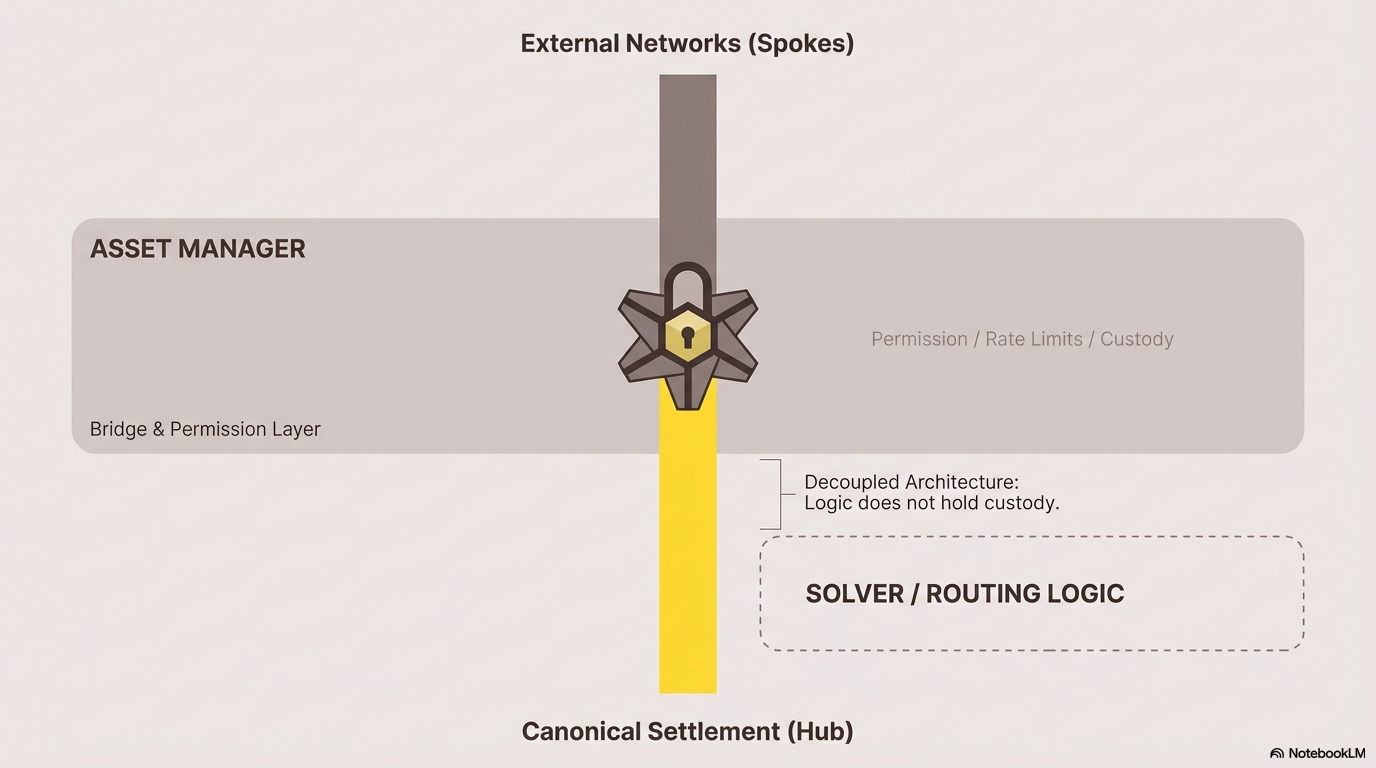
The Asset Manager is the bridge and permission layer that authorizes and moves assets into and out of the SODAX system.
What it is
The Asset Manager is the smart contract layer that handles token permissions and cross-network asset movement inside SODAX. It exists in two forms:
- A Hub Asset Manager deployed on Sonic, which integrates assets into the system’s canonical settlement environment.
- Spoke Asset Managers deployed on supported networks, where users grant permissions and initiate asset entry.
It is not a treasury, not a routing engine, and not a pricing layer. It is the infrastructure that enables assets to move between networks as part of the bridge + action model.
What it does inside SODAX
Within SODAX, the Asset Manager is responsible for authorizing and executing asset transfers that support cross-network actions.
Before an Intent can be fulfilled, the Asset Manager validates that the correct token and amount have been approved. On EVM networks, this occurs through token approvals. On networks such as Stellar, it includes trustline management.
Once authorized, the Asset Manager enables assets to enter the execution flow. Assets are then bridged to the Hub, where actions occur, and may later be bridged out to a destination network.
The Asset Manager does not determine routing paths, calculate prices, or decide how liquidity inventory is used. It provides the controlled bridge interface through which assets move. It also interfaces with rate-limiting logic to enforce movement constraints.
Why it exists
Cross-network execution requires assets to move safely between heterogeneous environments. Without a dedicated bridge and permission layer, routing logic and custody logic would become tightly coupled. The Asset Manager exists to isolate asset movement from execution decision-making. By separating bridge infrastructure from Solver reasoning:
- The Solver does not require direct custody of user tokens.
- Execution planning remains independent from token authorization.
- Asset movement can be rate-limited and monitored without affecting routing logic.
- The system maintains a consistent bridge interface across networks.
This separation keeps the architecture modular and easier to reason about.
What this means for users and partners
For users, the Asset Manager ensures that only explicitly approved amounts can move and that assets follow a predictable bridge path into and out of the system.
For builders, it provides a clear integration point for asset authorization without embedding routing logic into token contracts.
Component boundaries remain explicit:
- The Asset Manager handles bridge and permission logic.
- The Solver decides how an Intent is fulfilled.
- The Coordinator structures execution steps within the Solver.
- The Hub records final settlement state.
- Liquidity inventory provides the resources used for settlement.
The Asset Manager enables bridge + action flows. It does not decide what action occurs.