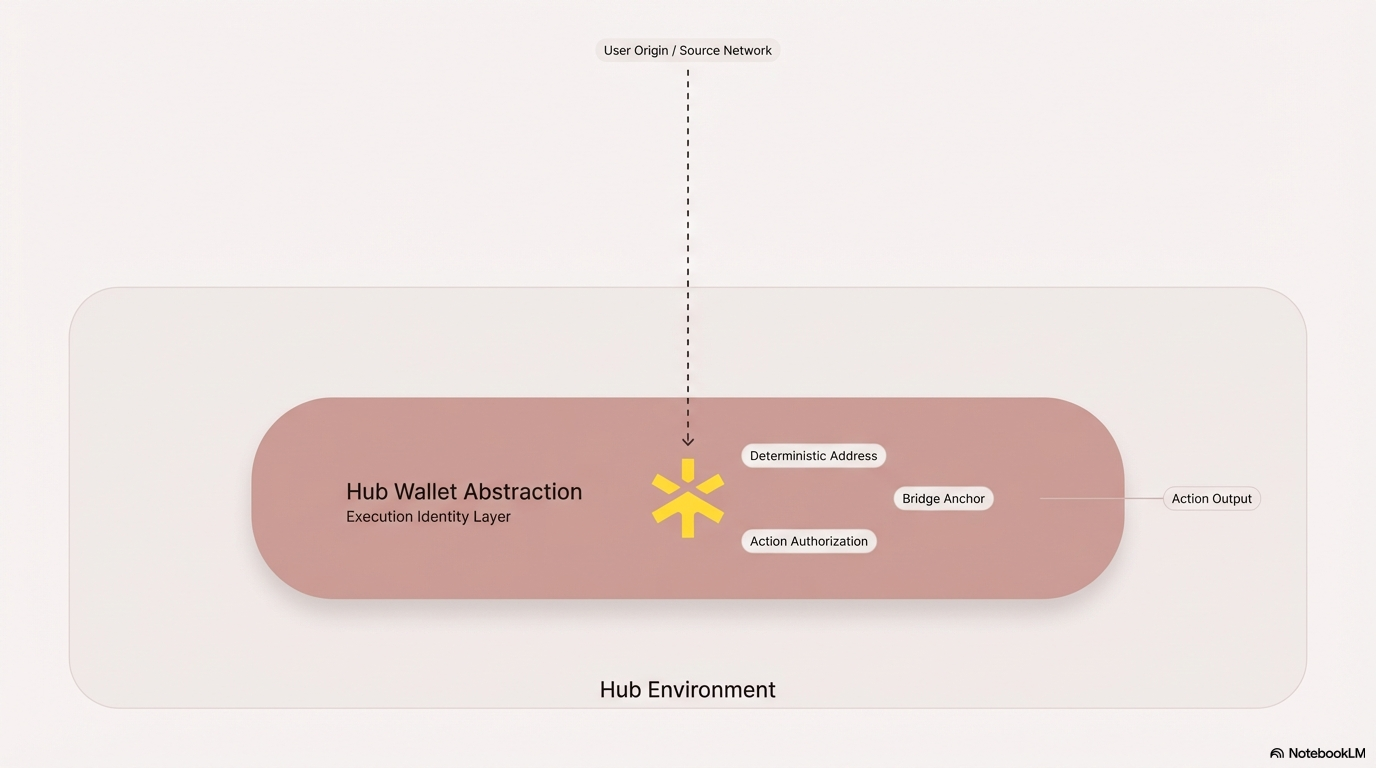
Hub Wallet Abstraction (Wallet Factory)
Hub Wallet Abstraction is the deterministic smart wallet system on the Hub that provides each user with a stable execution identity for cross-network actions.
What it is
Hub Wallet Abstraction is the system that generates a deterministic smart wallet for each user on the Hub.
When a user interacts from a supported network, their source address maps to a predictable proxy wallet on the Hub. This wallet is created through the protocol’s factory contract and serves as the execution identity for cross-network actions.
It is not a consumer wallet and it is not a custody replacement. It is an execution surface inside the Hub.
What it does inside SODAX
Within SODAX, the Hub Wallet acts as the on-chain identity through which bridge + action flows are executed. When a user signs an Intent, that authorization allows the corresponding Hub Wallet to:
- Receive bridged assets.
- Interact with the Asset Manager.
- Execute swaps or deposits on the Hub.
- Coordinate multi-step actions tied to that identity.
Because the wallet address is deterministic, assets can be bridged to it even before the wallet is explicitly deployed. This ensures that bridge operations do not fail due to missing contract state.
The Hub Wallet does not calculate routes, move assets independently, or decide how liquidity inventory is used. It executes logic that has already been authorized and structured by the Solver.
Why it exists
Cross-network execution requires a stable on-chain identity at the coordination layer.
Without a deterministic Hub wallet:
- Bridged assets could arrive without a defined execution surface.
- Multi-step flows would require additional message handling.
- Recovery logic would be more complex.
Hub Wallet Abstraction ensures that every user has a predictable execution anchor on the Hub. Assets always land in a known location, and actions can be coordinated without relying on external wallet state. This reduces failure modes in bridge + action flows.
What this means for users and partners
For users, Hub Wallet Abstraction is invisible. A single signed Intent can trigger multi-step actions because the system has a stable execution identity on the Hub.
For builders, it clarifies that user identity at the coordination layer is contract-based and deterministic, not dependent on manual wallet deployment.
Component boundaries remain clear:
- The Hub Wallet provides execution identity.
- The Solver determines how an Intent should be fulfilled.
- The Coordinator structures execution steps.
- The Asset Manager moves assets.
- The Hub records final settlement state.
- GMP and the Relayer deliver cross-network instructions.
The Hub Wallet does not manage liquidity or custody. It provides the stable identity required for cross-network execution.